
By Anne Fonda with expert review by Mark Woodruff, Senior Product Manager, Air Conditioners
HVAC Basics: How Do Air Conditioners Work?
How air conditioning works
The underlying principles are the same for central air conditioning, ductless mini-split air conditioning, window AC units, portable air conditioners, and even your car AC. But of course, our focus in this HVAC Basics article is on central air conditioning, which uses ductwork to distribute the air throughout your home.
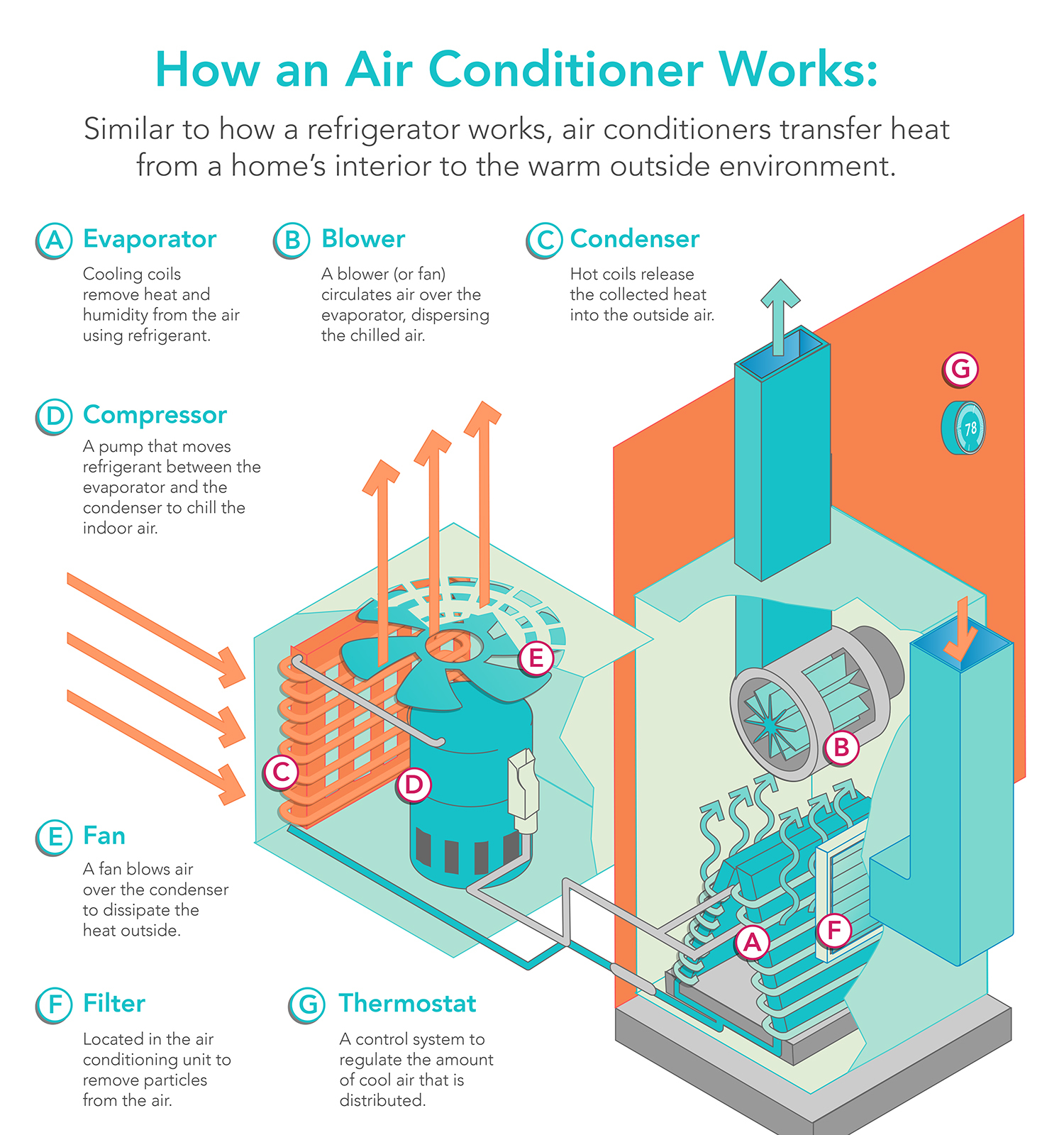
The system components work together in the refrigeration cycle to reduce the heat and humidity in your home, making you feel cool and comfortable.
Source: U.S. Department of Energy
Air conditioner components
There’s a set of unique parts within each type of air conditioner that all work together to cool.
The thermostat is the brain behind your heating, ventilation, and air conditioning (HVAC) system. When the temperature rises above your set temperature, your thermostat signals your air conditioner to start running.
Traditional, programmable, and smart thermostats are all options, with smart thermostats offering the most energy-saving options and convenience. Some new systems will require a smart, communicating thermostat to ensure you get all of the benefits the system has to offer.
Refrigerant is the lifeblood of the air conditioning system. It runs through the entire system in a closed loop, absorbing, carrying, and releasing heat at various points in the cooling cycle. When the cooling process begins, the refrigerant’s first stop is in the evaporator coil to absorb heat from the air in your home.
The evaporator coil is made of a metal that conducts heat very well, like copper or aluminum. In a traditional split system, it’s located in a case next to the furnace or inside the air handler that is paired with your air conditioner.
The compressor is the heart of the cooling system, pumping and circulating the refrigerant at an adequate pressure. It receives cool & low-pressure refrigerant from the evaporator coil and compresses this to a high pressure / high temperature condition. This high-temperature refrigerant flows to the condenser coil to cool and dissipate heat.
The condenser coil is located in the outdoor AC unit and is responsible for releasing the heat the refrigerant is carrying to the outside. Once the heat is released from the refrigerant, it cools down in the condenser coil to get ready to absorb more heat from your home.
The refrigerant leaving the condenser coil will reach an expansion valve just before entering the evaporator coil. The expansion valve restricts the refrigerant flow to lower the pressure and the temperature. The cooler refrigerant flows out of the valve and into the evaporator coil, and the cycle starts again to maintain the set temperature.
What factors affect the comfort that an air conditioner provides?
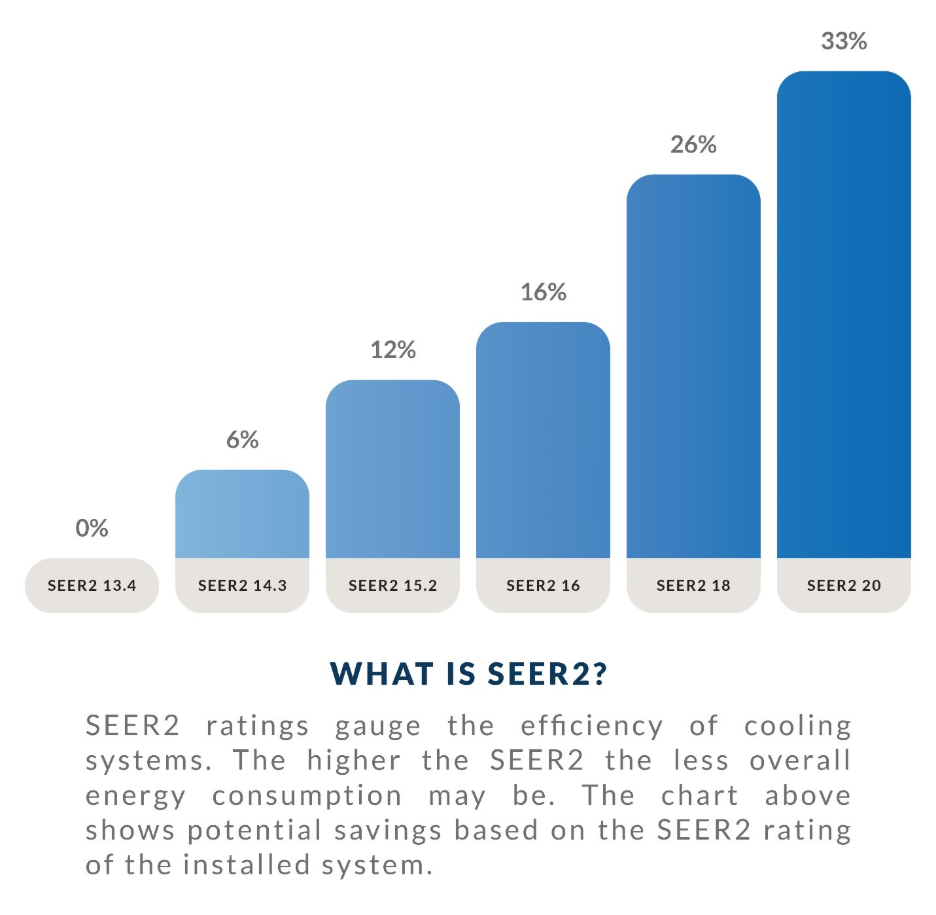
All air conditioners receive a SEER2, or Seasonal Energy Efficiency Ratio, rating. A unit’s SEER2 reflects an average of how efficiently it cools during the entire cooling season, in temperatures from 65°F to 104°F. Minimum SEER2 rating requirements in the U.S. are dependent on region, system type, and system capacity, so be sure to talk to your local American Standard dealer to determine the SEER2 rating that’s right for your home.
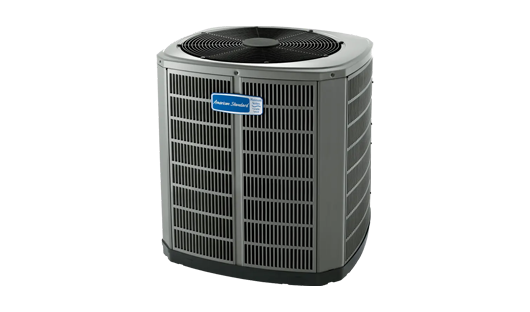
Another factor that can affect your cooling comfort is the number of stages (or speeds) the air conditioner has. These include single-stage, two-stage, multi-speed, and variable speed systems.
“The number of speeds or stages an air conditioner has typically translates to higher energy efficiency and better comfort… so the more variability or number of stages, the more efficient the equipment will operate and the better temperature and humidity control the system can deliver to your home.”
- Mark Woodruff, Senior Product Manager, Air Conditioners
Types of central air conditioning systems
There are two types of central air conditioning systems: split systems and packaged systems.
A traditional split system has an outdoor air conditioner and an indoor furnace or air handler. Central air conditioning systems rely on supply ducts to circulate cool air through your entire home and return air ducts to continue the cycle.
The split system includes the outdoor AC unit and an indoor furnace or air handler. Refrigerant lines connect the outdoor unit to the indoor evaporator coil. The indoor unit also includes the blower fan, which circulates indoor air over the evaporator coil.
Packaged air conditioners are central air conditioners; the only difference is that the entire system is placed outside the home. They still cool your home using ductwork, but don’t have an indoor furnace or air handler.
Packaged systems work well for homes with limited indoor space. They can sit outside your home or on the roof, in some situations. While AC-only packaged units are available, you can also opt for a gas furnace + air conditioner packaged system for complete heating and cooling.
Related products
Related articles
Anne Fonda, Content Writer
A Content Writer with Trane Technologies, Anne Fonda researches topics and writes for Trane® and associated residential HVAC brands. She works in collaboration with Trane Technologies subject matter experts, offering easy-to-understand, informative content on complex topics. Her goal is to help consumers make informed decisions on the products and services they need.
She has written for HVAC and other service provider websites for over 16 years. Before transitioning to web content writing, Anne had a 14-year stint as an award-winning journalist. She graduated cum laude from the University of Missouri-Columbia School of Journalism.
When she’s not working, Anne enjoys playing word games, reading, gardening, spending time with family, and visiting gardens and museums.