Published: August 19, 2024
Homeowner’s Guide to HVAC Refrigerants
Get the complete guide to HVAC refrigerants from American Standard®. Reach out to your local dealer for questions, AC repair, and air conditioner replacement.

Summary
HVAC refrigerants are the lifeblood of your home’s cooling system. Air conditioning units and heat pumps alike use a refrigerant. Big changes are happening in the HVAC industry when it comes to which refrigerants to use in newly manufactured products. We’ve assembled this guide to help homeowners like you understand HVAC refrigerant history and the more sustainable refrigerants of the future.
In this article, we will answer some of the most frequently asked questions about HVAC refrigerants, including:
- What is a refrigerant?
- What is global warming impact?
- What is R-22?
- What is R-410A?
- Is R-410A being phased out?
- What is the new refrigerant for HVAC in 2024?
- Do I have to replace my air conditioner that uses an old refrigerant?
Let’s get started.
What is a refrigerant?
An HVAC refrigerant, or AC refrigerant, is a heat transfer fluid that helps cool your home during hot weather. It can take the form of a liquid or gas. Both air conditioners and heat pumps use refrigerant to cool the air. During the refrigeration cycle, refrigerants change phase from gas to liquid and back to gas as they absorb heat and transfer it to the outside.
Cars, refrigerators, and commercial applications all use refrigerants. However, for this guide, we will focus on residential HVAC refrigerants exclusively.
Why are we putting together a refrigerant guide now? Because there is a big transition going on in the HVAC industry, and it affects you, as a homeowner. We hope that by providing some information and answering common questions, you will understand the importance of refrigerants and how they affect not only your comfort but also the health of our planet.
What is global warming potential?
Global warming potential (GWP) is the potential a refrigerant (and other greenhouse gases) has to absorb and trap the sun’s heat in the Earth’s atmosphere. Scientists determine a refrigerant’s GWP by comparing its global warming impact relative to the amount of carbon dioxide that would cause an equivalent global warming impact. The higher the GWP, the greater the climate impact.
The GWP of various refrigerants is in the news because of new regulations limiting their use based on their global warming potential.
What are the AC refrigerant types?
There are several common types of refrigerants used in residential AC applications. One has already been phased out, one is currently being phased out, and the other two are the newer air conditioner refrigerants that the HVAC industry is transitioning to for residential products.
R-22 (Freon™)
R-22 refrigerant, also known by the brand name Freon, is still in use in some older air conditioners and heat pumps manufactured before 2010. It’s a hydrochlorofluorocarbon (HCFC) which is a chemical that is mainly used as a refrigerant. When released into the atmosphere, HCFCs deplete the Earth’s protective ozone layer and contribute to climate change.
Why is R-22 banned from new production?
The United States committed to an international effort to regulate and phase out substances with an Ozone Depletion Potential (ODP) such as R-22 when it joined countries worldwide to ratify the Montreal Protocol on Substances that Deplete the Ozone Layer. In 2010, the U.S. ceased new production and importation of R-22 except for servicing existing units.
Is R-22 still available?
Yes and no. R-22 is no longer being produced or imported into the United States for any reason. That final ban went into effect in 2020. However, due to recycling and refrigerant recovery from decommissioned AC units, R-22 is still available in limited quantities.
That means if you have an older air conditioner that uses R-22, you can still get it serviced and recharge the refrigerant. But if you need a new central air conditioner or heat pump, it will use a newer refrigerant.
R-410A
R-410A is the R-22 refrigerant replacement that the HVAC industry transitioned to in AC units and heat pumps manufactured in 2010 and later. It’s a blend of hydrofluorocarbon (HFC) compounds R-32 and R-125.
Is R-410A being phased out?
Yes. Much like R-22 was phased out, R-410A is being phased out, for similar reasons - there are newer, more sustainable alternatives. In the 2020 American Innovation & Manufacturing (AIM) Act, the Environmental Protection Agency (EPA) gained the authority to set stringent standards for HFC use.
In September 2021, the EPA released a detailed plan to drastically reduce HFC consumption in a phased approach. Beginning in 2025, the plan prohibits using R-410A refrigerant in newly manufactured HVAC equipment.
How long will R-410A refrigerant be available?
R-410A will be available for years to come, and there will also be a supply of recovered R-410A as people replace aging AC units. In addition, HVAC manufacturers will have an inventory of heat pumps and air conditioners that use this refrigerant which they can continue to sell until inventory is depleted.
What refrigerants will replace R-410A?
After countless hours of research, most HVAC manufacturers, including American Standard, have agreed that the best replacements are R-454B and R-32 refrigerants. They will be phased in for newly manufactured HVAC cooling equipment such as air conditioners and heat pumps.
R-454B
R-454B is the newest refrigerant, which will gradually replace R-410A, the refrigerant used in HVAC manufacturing from 2010 until the phase-out is complete in January 2025. R-454B is a blend of R-32, a hydrofluorocarbon (HFC), and R-1234yf a hydrofluoroolefin (HFO). This blend enables energy efficiency and performance while reducing the potential for environmental impact, i.e. it provides a significant reduction in GWP.
Can R-454B be used in an R-410A system?
No. R-454B is not compatible with older systems. The EPA is phasing out manufacturing units that use R-410A but is still allowing its use in existing systems.
R-32
While R-32 is a component of R-454B, it is also a single-component refrigerant. R-32 also has good performance characteristics, and it has a much lower GWP than R-410A. R-32 has been in use in China, Japan, and India for years.
Environmental impact of HVAC refrigerants
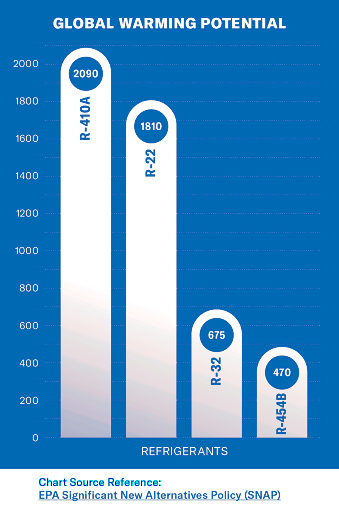
Refrigerants with a higher GWP are one of the many potential drivers of climate change. That’s why the EPA is phasing out R-410A. Compare the GWP of the various refrigerants in the graph above, and you’ll see newer refrigerants are much more sustainable. In addition to being low GWP refrigerants, R-32 and R-454B have zero ozone depletion potential.
American Standard and the refrigerant transition
American Standard commits to using low GWP refrigerants in HVAC products by 2025. This commitment is in line with global environmental goals and new federal regulations.
We are committed to moving away from fossil fuels through fully electric and hybrid systems, offering more energy-efficient products, incorporating more eco-friendly manufacturing processes, and have dedicated countless hours to sourcing lower GWP refrigerants that exceed government regulations.
American Standard utilizes new technology and sustainable practices to create energy-efficient HVAC products. These products can assist in saving energy and decreasing your carbon footprint. Transitioning refrigerants is another step in helping to ensure a sustainable future.
We’re gradually switching to new, more sustainable refrigerants, starting with the adoption of R-454B for use in our residential products. The phased approach will assure homeowners that all units will surpass safety standards. Our first product using the new refrigerant is the Silver 15 Heat Pump.
Learn more about our commitment to sustainability and the refrigerant transition.
Proper handling and maintenance of HVAC refrigerants
As a homeowner, you should never handle HVAC refrigerants. That is something your HVAC technician will do when needed. This can include fixing a refrigerant leak or recharging (refilling) your refrigerant as needed. They are also trained in the proper disposal and recycling methods for HVAC refrigerants.
Do I need AC repair or replacement?
If you have an older AC system or heat pump that uses R-22 (manufactured in 2009 or earlier), the unit is nearing the end of its lifespan. While you can spend money on repairs and recharging the refrigerant, you may want to consider replacing the unit sooner rather than later.
If you have an air conditioner or heat pump that uses R-410A refrigerant and is approaching 15 years in service, you may also want to start considering air conditioner replacement or heat pump replacement. But if it’s only a few years old and running efficiently and you’re keeping up with HVAC maintenance, you can probably deal with smaller repairs as they come up for years to come.
Check out our Repair or Replace Guide to help you make an informed decision.
Get expert advice and HVAC product recommendations
Do you need AC repair? Are you considering an air conditioner replacement? Maybe you’re interested in a heat pump system. Whatever your HVAC needs, you can trust your local American Standard dealer to provide solutions and recommendations tailored to your home.
For over 100 years, we’ve designed and manufactured some of the most awarded, well-engineered heating and cooling equipment and earned a reputation for doing things right.
Expert review by Jeff Stewart, Refrigeration Chief Engineer