Published: February 10, 2025
HVAC Air Filter Replacement: Everything You Need to Know
Discover why changing your HVAC air filter is so important, and how to buy the right replacement filters as well as how to replace the old filter.

Summary
Learn where your HVAC air filter is, how to change it, and how to decide what size and type of filter is best for your home.
Your HVAC system works hard to heat and cool your home. If you’re like most homeowners, you take it for granted and don’t give it a lot of thought – until something goes wrong. Did you know that you can prevent problems and prolong the life of your furnace, air conditioner, or heat pump by simply changing the air filter regularly?
Keep reading to learn everything you need to know about air filter replacement, from signs of a dirty filter to how to replace it to buying the right replacement filters.
Let’s get started.
Signs of a dirty HVAC air filter
There are several clear (and less clear) indicators of a dirty or clogged air filter, including:
- Your thermostat display says it’s time to change/clean the filter.
- The Home App sends you a notification that it’s time to change the filter.
- The filter looks dirty/fuzzy.
- Family members are sneezing or coughing and showing allergy symptoms.
- Your house is dustier than normal.
- Your energy bills are creeping up while your energy usage stays the same.
It’s important to change your air filter regularly, to avoid problems.
What problems can a dirty HVAC air filter cause?
A dirty or clogged air filter can cause a host of problems, some more serious than others, including:
- Allergy symptoms among family members with allergies
- Respiratory symptoms for people with asthma or COPD
- Uneven heating and cooling
- Increased utility bills as the system works harder
- Unexpected (and potentially costly) HVAC repairs
Some of these problems have other causes, but checking your air filter is a good place to start your HVAC troubleshooting.
Where is my HVAC filter?
If you’re a new homeowner, you’ll need to locate your HVAC system components.
If you have a traditional split system, the HVAC air filter will most likely be located next to the furnace or air handler. The indoor unit may be located in your basement, attic, or utility closet. Look for a small cabinet next to the larger unit – it may have a pull-out door or a cover that comes off.
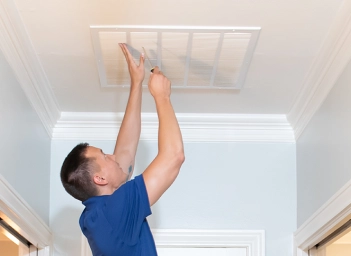
Alternatively, the HVAC air filter may be located in a large return air vent located in a wall or ceiling. These large vents are generally hinged where you can move some clips to open the vent grate to access the filter.
The exact location of your air filter will be based on the construction of your home or if you have a packaged system where both the heating and cooling components are located in one cabinet outside your home.
How often should you replace the HVAC filter?
How often to replace a furnace filter or air conditioner filter will depend on the quality of the filter, whether you have pets and other factors. In general, you should replace the air filter every 30-90 days. Look for the signs of a dirty filter mentioned above to help set the proper heat pump, furnace, or air conditioner filter replacement schedule for your home.
What size air filter do you need?
Using the right size of air filter will help your system run more efficiently and trap more allergens and pollutants. Check the existing HVAC air filter. It will likely have measurements printed on it. If the filter fits snugly, this is the size you need.
AC filter sizes and furnace filter sizes are expressed in inches – length x width x depth (thickness).
If your air filter doesn’t have measurements marked on it, you can measure it yourself and then buy the same size. The actual size reflects the true measurements of an air filter when measured.
This can be a very specific number such as 15.5 x 24.5 x .75, whereas the nominal size is rounded up to make the process of buying air filters simpler. In this case, the nominal size would be 16 x 25 x 1 and would be the size you need to purchase.
What type of air filter should you buy?
It depends. We would generally recommend avoiding the ultra-cheap fiberglass filters, as they don’t filter out much. For just a little bit more, you can improve your home’s indoor air quality (IAQ) and help your HVAC system run more efficiently.
Consider a pleated filter or pleated electrostatic air filter to capture more allergens and particles. Air filters will have a MERV rating, which stands for Minimum Efficiency Reporting Value. It’s an industry-standard measurement of how effective an HVAC air filter is at filtering out particles .3 to 10 microns in size.
In general, the higher the MERV, the more efficient the filter is. Most HVAC companies will recommend a filter with a MERV rating between 8 and 13 for residential use. Talk with your HVAC company about what filter is best suited for your existing system.
Should you upgrade your air filtration system?
Maybe. If someone in your family suffers from allergies, asthma, or a respiratory illness, you might want to consider upgrading to a whole-house air cleaner that filters out all but the smallest particles. You might also want a more effective air filtration system if you have pets or live in an area prone to wildfires.
American Standard has two options: The QuikBox™ air cleaner and the AccuClean® air cleaner. Each has its own benefits. Talk with your local dealer for specifics on installation.
How to replace a furnace filter/heat pump filter/air conditioner filter
The procedure to replace your HVAC filter is pretty much the same, regardless of whether you have a furnace + AC system or a heat pump heating and cooling system.
- Turn off your HVAC system using the thermostat, circuit breaker, or power switch.
- Open the access cover or return air vent and remove the dirty filter. Pay attention to which way the arrow on the filter points, because that shows you how to orient the new filter.
- Insert the new filter with the arrow pointing toward the air handler or furnace. This ensures large and small particles are filtered out before the air enters the HVAC unit.
- If it's hard for you to remember which way to point the arrow, draw an arrow on the indoor unit.
- Close the cover.
- Turn the system back on.
If you have a hard time remembering to change the filter and your thermostat doesn’t display an alert, put a repeating calendar event in your phone. You can also sign up for automatic shipping from an HVAC filter replacement website.
A note about whole-house air cleaners and ductless mini-splits
Whole-house air cleaners such as QuikBox™ and AccuClean® have much more efficient filtering systems and thus have different schedules for replacement or cleaning. Mitsubishi ductless mini-splits have cleanable filters.
QuikBox™: Replace the QuikBox™ whole-home air cleaner filter every 6 months.
AccuClean®: The AccuClean® whole-house air cleaner has a removable, cleanable filter. Follow the directions in your owner’s manual to gently vacuum (using a hose attachment) the accumulated dust and debris off of the filter.
Ductless mini-splits: Ductless mini-split units have removable air filters similar to a window or wall AC unit. Follow the directions in your owner’s manual and gently vacuum and/or rinse the air filters and allow them to dry before replacing them. The following video may help.
Still have questions about your air filters? Get help now.
Contact your local American Standard dealer for help upgrading your air filtration system or just to answer general questions and give product recommendations for replacement air filters.
Expert review by Sean Goddard, Product Manager, Coils & Indoor Air Quality